


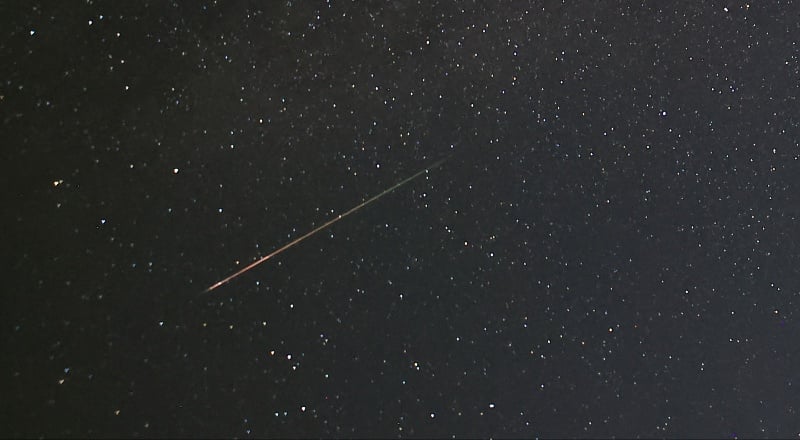
Here's when and how you can catch the Perseid Meteor Shower in KSA


Look up
Saudi Arabia’s glorious skies will be witnessing one of the world’s most beautiful celestial wonders this week. The annual Perseid meteor shower in KSA will be visible to the naked eye, and here’s how and when you can catch it.
Set to be at its peak on Wednesday August 12, in the evening, continuing through dawn on Thursday August 14, the Perseid meteor shower in KSA could have avid viewers in dark locations see up to 100 meteors per hour.
Saudi skies will witness the peak of the Perseid meteor shower on the night of August 12, featuring up to 100 meteors per hour. #Saudi_Space_Agency pic.twitter.com/sjWj0GGPWR
— وكالة الفضاء السعودية (@saudispace) August 10, 2026
According to the Noor Astronomy Society, the phenomenon occurs as Earth passes through debris from Comet Swift-Tuttle, causing tiny particles to burn up in the atmosphere at high speeds. Viewing conditions are ideal this year, as the peak coincides with the end of the lunar month, ensuring minimal moonlight interference.
Saudi Arabia’s stunning landscapes make it an ideal location for astronomy year-round, with desert regions and minimal light pollution; it really is the perfect place to catch the wonders of the universe in action.
Known for its bright fireballs with an intense glow, the Perseid meteor shower’s name appears to have radiated from the Perseus constellation.
When to catch the shower
The best viewing time in Saudi Arabia starts at 1am and will go on until sunrise. Under ideal dark sky conditions, you can see 75 to 100 meteors per hour.
How to watch
- Location: Travel to dark desert areas or open spaces well away from city light pollution to ensure the best conditions.
- Preparation: Allow your eyes about 15 to 20 minutes to adjust completely to the dark.
- No equipment is needed as the meteor shower is visible to the naked eye.
Throughout August, skywatchers will also be able to observe prominent appearances by Venus, Saturn, Jupiter, and Mars, along with the seasonal transition from summer to winter constellations, per Arab News.
Image: Getty