





Flight updates in Saudi Arabia: What travellers need to know


Travellers, take note
If you’re flying in or out of Saudi Arabia, it’s worth double-checking your booking before heading to the airport.
Ongoing regional developments have led several airlines to cancel or adjust flights as a precaution, particularly on routes impacted by temporary airspace closures. Airlines such as Saudia, Flynas, and Flyadeal have all issued updates advising passengers to check their flight status directly through official websites or apps.
But first, is Riyadh airport open?
One of the main questions circulating today is whether Riyadh’s airport is still operating.

The good news: King Khalid International Airport (RUH) has not shut down.
Although the airport has been affected by the wider regional situation, it remains operational. Flights are being managed carefully due to ongoing airspace disruptions.
Unlike some Gulf airports that temporarily suspended operations altogether, RUH has remained open – although certain flights may be delayed, diverted, or cancelled depending on evolving airspace advisories and airline decisions made with safety in mind.
In short, the airport remains open, but schedules are flexible.
Airlines are advising travellers to check directly with their carriers before heading to the airport, as the situation continues to unfold.
Saudia
بيان إلحاقي من #الخطوط_السعودية pic.twitter.com/bP3M8albJ2
— Saudia Group | مجموعة السعودية (@SaudiaGroup) February 28, 2026
Saudia, the Kingdom’s first flag carrier, announced through its official channels that several flights to destinations including Amman, Kuwait, Abu Dhabi, Dubai, Doha, Bahrain, Moscow, and Peshawar have been cancelled until Monday March 2. Passengers are advised to verify the status of their bookings before travelling, and to contact their travel agent or the airline’s customer service if plans change.
Flynas
Supplementary Statement
Sunday, 1 March 2026 pic.twitter.com/9W0mx5oZmo— flynas طيران ناس (@flynas) March 1, 2026
Similarly, Saudi Arabia’s first-ever budget carrier, Flynas, cautioned that due to ongoing airspace closures in certain areas, some routes may be delayed or cancelled. Passengers are advised to check their flight status on the airline’s website or customer support lines, and Flynas states it will provide updates as conditions change.
Flyadeal
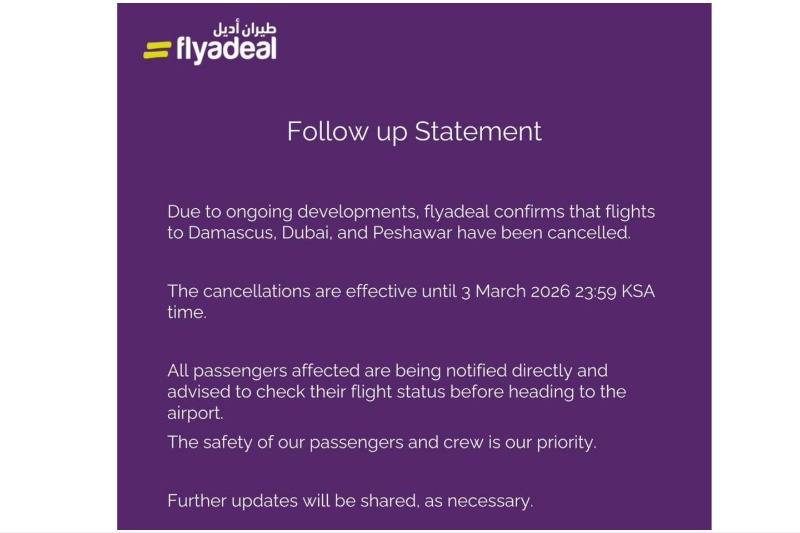
Low-cost airline Flyadeal also advised passengers to double-check their itineraries on its app or website, noting that cancellations – including flights to Damascus, Dubai, and Peshawar – are expected until Tuesday March 3. Affected travellers will be notified directly by email or text.
Across the board, airports, including King Khalid International and King Fahd International, are echoing the same advice: contact your airline before you travel. That way, you won’t be caught off guard by last-minute changes.
Other global carriers
The disruption isn’t limited to regional airlines. A number of major international carriers, including Air France, KLM, Air India, Cathay Pacific Airways, Emirates, Etihad Airways, Indigo, Lufthansa, Malaysia Airlines, Scoot, Qatar Airways, and Turkish Airlines, have also suspended or adjusted operations, citing passenger safety as their top priority.
As a result, tens of thousands of travellers across the region have been left stranded or facing significant delays as airlines continue to reassess routes in response to evolving airspace advisories.
For GCC nationals caught up in the chaos, Saudi authorities have activated a dedicated support hotline to assist stranded citizens at airports.
What happens now?
The situation remains fluid, and aviation authorities across the region are constantly reviewing conditions. While safety measures are precautionary, further schedule changes may be necessary if tensions escalate or additional airspace restrictions are imposed.
For now, flexibility is key. If your travel is non-essential and easily rescheduled, it may be worth considering alternative dates until operations fully stabilise.
But if you’re travelling:
- Check your airline’s website or app before leaving home
- Allow extra time
- Keep an eye on SMS or email notifications
Things are shifting quickly, and airlines are adjusting in real time. For now, operations continue, just with a little more caution than usual.
We’ll continue to update as more information becomes available.
Images: Social / Unsplash